
Waxwings
| Order: PASSERIFORMES - Family: BOMBYCILLIDAE |
| 3 Species currently existing - 1 in region |
Appearance: The Cedar Waxwing is a sleek, medium-sized bird (about 18 cm long) with a smooth, silky appearance. It has a pale brown head and chest that gradually fade into gray wings and a soft yellow belly. A distinctive black mask bordered with white crosses the eyes, giving it a “bandit-like” look. Its tail is gray with a bright yellow tip. One of its most unique features is the small red, wax-like tips on the wing feathers, which give the species its name. It also has a subtle crest on the head and a short, wide bill.
Habitat: Cedar Waxwings inhabit open woodlands, forest edges, orchards, and suburban areas where fruiting trees and shrubs are abundant. They are especially common near streams or water sources and are often seen in parks, gardens, and agricultural areas. Their presence strongly depends on the availability of berries.
Behavior: Cedar Waxwings are highly social birds, usually found in flocks year-round. They are known for their cooperative feeding behavior, sometimes passing berries from one bird to another before eating them. Their diet consists mainly of fruit (berries), although they also eat insects—especially during the breeding season. They are agile flyers and often catch insects in mid-air. Their vocalizations are high-pitched, thin whistles or trills, frequently heard during flight.
Breeding: Cedar Waxwings breed in late spring and summer. The female builds a cup-shaped nest made of twigs, grasses, and soft materials, usually placed on a horizontal tree branch. She lays 2–5 eggs, which she incubates for about 11–13 days. Both parents feed the chicks, which leave the nest after about two weeks but continue to be fed for several days afterward. Pairs may raise one or two broods per season.
Conservation Status: The Cedar Waxwing is classified as Least Concern (LC) by the IUCN.
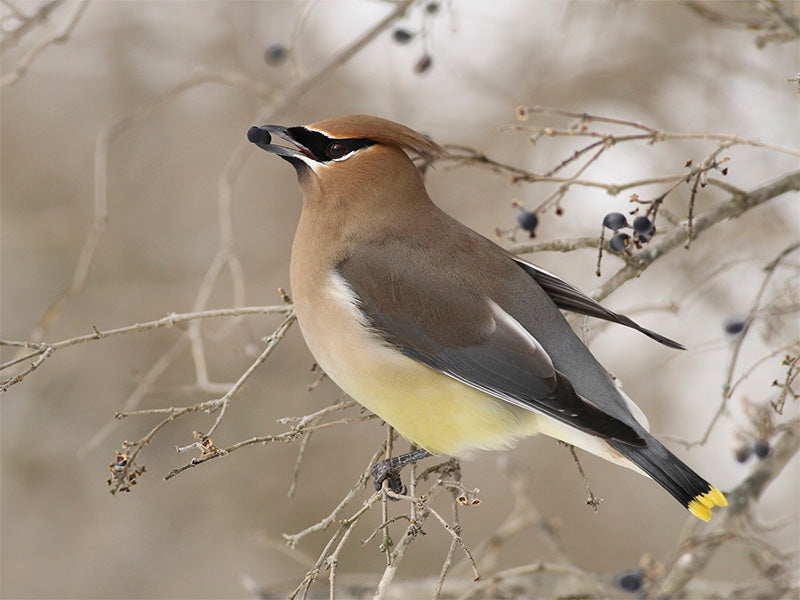
Cedar Waxwing
Bombycilla cedrorum
Spanish Name: Cedar Waxwing
Size: 7 in | 18 cm
Habitat: Forested areas
Height: 800 - 1600 m
Photo: © Evan Lipton eBird S22332879 Macaulay Library ML 51360301
